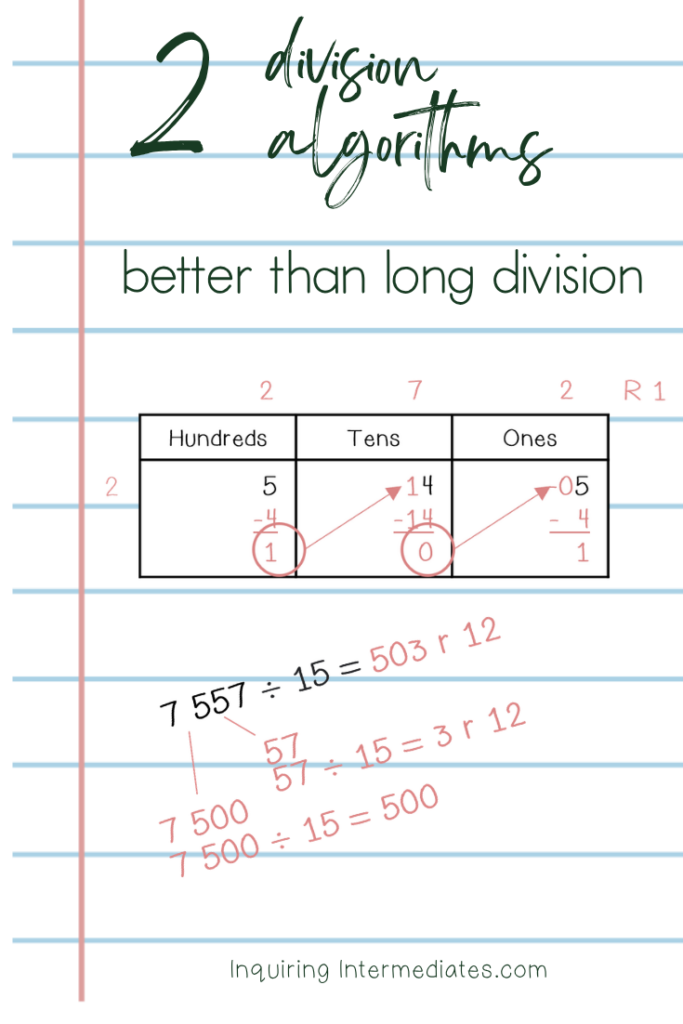
Wait... what's wrong with long division?
There’s nothing wrong with long division. I mean, it works… But, let’s face it: long division kind of sucks! As a kid who had no idea how math worked and relied solely on memorisation, long division was my elementary school nemesis. For the life me, I could not keep those steps straight! I could memorise “divide, multiply, subtract, and bring down”, but I was always losing
track of which steps I’d just done. I’ve found a lot of my students struggle with the same problem.
I’m embarrassed to admit that, when I first started teaching, long division was the only multi-digit division algorithm that I taught. I thought teaching multiple division algorithms would confuse students; I’ve heard families say the same. It’s probably true that, if math was just a memorisation game, multiple strategies would muddle things. Thankfully, math is really about logic and place value. If kids have a good sense of place value, they can understand how different multiplication and division algorithms work. Then, they can sift through the strategies and find the one that works best for them.
I still teach long division because it’s a relatively common strategy in North America and kids will probably be asked to use it at some point. However, I teach long division after these other two division algorithms.
The Split Method for Division (division with decomposition)
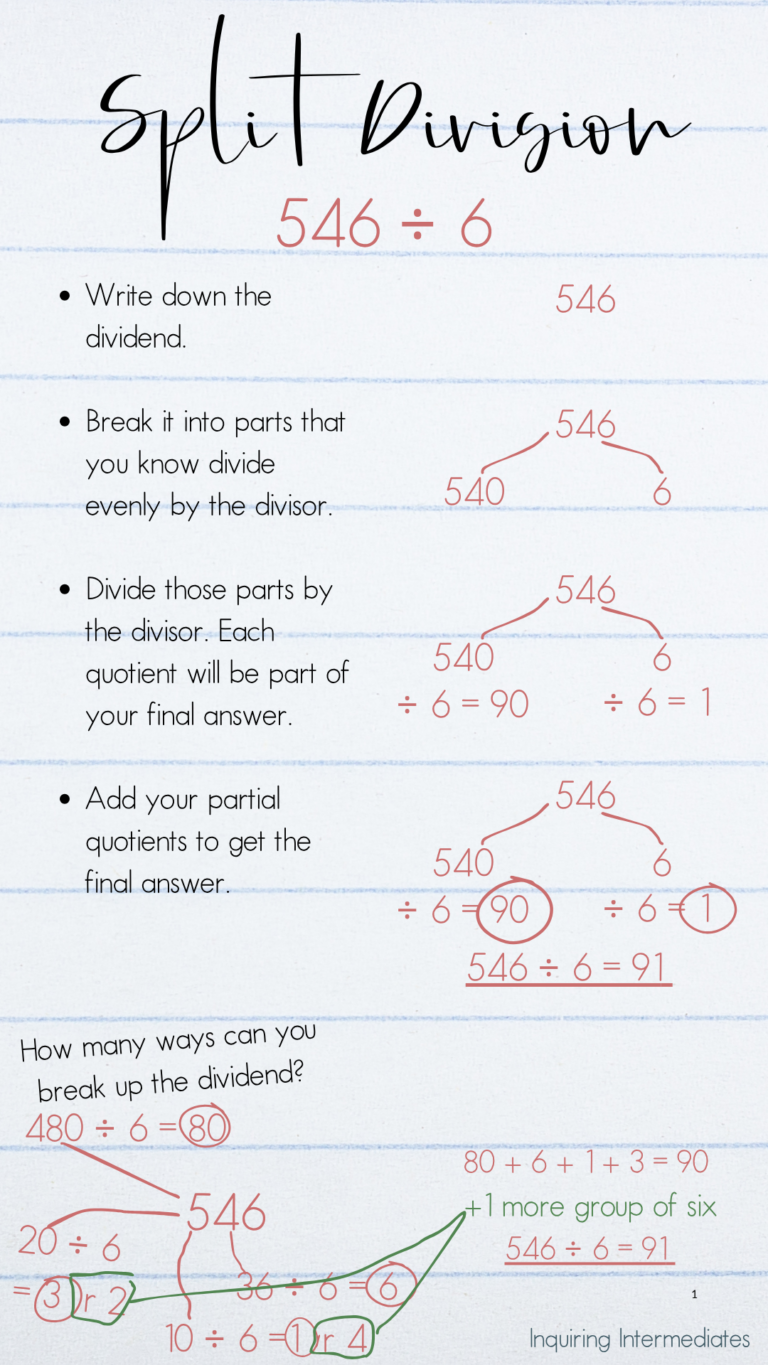
The split method for division is the division algorithm that I teach first. I usually teach multi-digit division after multi-digit multiplication. During our multiplication lessons, I really hammer home that numbers are a sum of their place value parts, and we can take them apart to make them easier to work with. The split method for division builds on that understanding. It uses decomposition to take numbers apart and divide their pieces.
Pros:
· This method builds on kids’ understanding of place value and the basic multiplication facts they are most familiar with.
· Even kids who don’t know many multiplication facts can use this strategy. Let’s look at the question in the picture, for example. If a student only knew 6 x 10, they could break 546 into 9 groups of 60, then pull the 6 out by itself. It would be inefficient, but it would work!
· It mimics how most of us would do mental math. When kids get comfortable with this method, they love showing off the big numbers they can divide in their heads. I tell them this is the on-paper version of mental math division.
· Students who really struggle with remembering the steps of other methods often find success with this one. It’s not about memorising a set of steps and executing them perfectly; there are multiple ways to approach each question.
Building conceptual understanding with the split division algorithm
Conceptual understanding is baked into this model! You can challenge
kids to use this method to think flexibly about numbers with the following
prompts:
· In a small group, share and compare how you broke the dividend up.
· How many ways can you break up and divide the dividend?
o These split division worksheets include questions where students break up the dividend multiple ways.
· Solve the equation by breaking the dividend into the fewest number of pieces.
· Solve the equation as inefficiently as possible.
· Solve the equation without a particular set of multiplication facts (ex. “how would you solve this if you did not know how to multiply by 5? By 10?” etc.).
· Correct the teacher
o o Purposefully make a mistake and have students teach you what you did wrong. Some examples of mistakes could include leaving a remainder that is equal to or bigger than the divisor (in the example in the photo, that would mean neglecting to notice that a remainder of 2 and 4 actually means another group of six). Another example could be leaving out a zero in your partial quotient. These split division worksheets include similar exercises.
Box Division (wide division)
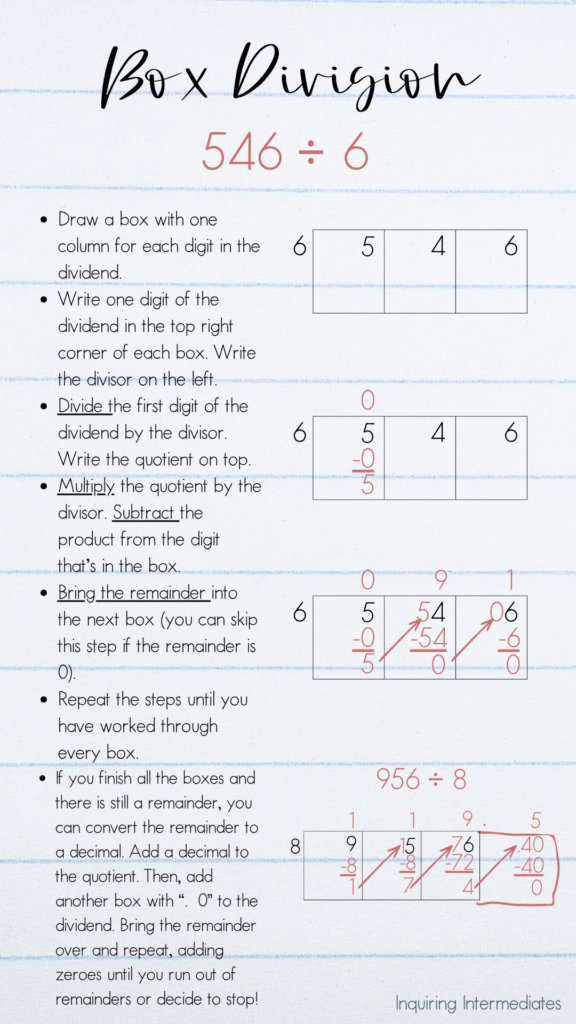
This multi-digit division algorithm is basically the wide version of long division. Where long division goes down, the box division algorithm goes across. The process is basically the same, but my students tend to find it way easier.
Pros:
· This method makes each step in the multi-digit division process very clear. It is easy for students to see the pattern of steps because each set is contained in a neat and tidy box. I find kids often lose track of their steps with long division; that doesn’t seem to happen with box division.
· Students and family members who already know the long division model of multiplication can easily figure out the box division method.
For both methods, the only real ‘con’ is this: guardians may be less familiar with this model and may struggle to help their children with it. I have tried to address this ‘problem’ by sending home completed worksheets that explain the strategy.
Building conceptual understanding with the box division algorithm
This algorithm is much less ‘figureoutable’ than the split method. It’s especially important that we take the time to make sure students understand why it works. Consider asking them to work in pairs or small groups to explain why we do the steps we do. A sample answer might sound like this:
The first step is to figure out how many sixes go into five hundreds. And zero sixes go in… No, wait, lots of sixes go into five hundreds. Hmmm…
The first step is to figure out how many… hundreds… of sixes? How many six hundreds! The first step is to figure out how many groups of six hundreds go into five hundred. None. So, we put a zero on top, and we still have the five hundred left. We bring it over to make 54… no, 540. It’s 540 because the 54 is in the tens place.
Now, we’re looking at how many groups of sixty go into five hundred forty. 9 x 6 = 54, so 90 x 6 = 540. So, we put a 9 on top of the tens place.
Now, we only have the 6 left. We are trying to figure out how many sixes go into six. One, obviously. So, we put a 1 on top.
So, we can put 91 sixes into 546.
If you’re looking to introduce either of these division
strategies to your students, don’t reinvent the wheel! You can find print-and-go worksheets here. Each set is set up to scaffold students so they feel successful.
Tips for success:
· Start with multiplication first. After all, division is just backwards multiplication! Box multiplication (a.k.a. the area model) is one of my students’ favourite multiplication algorithms, year after year. I find it really helps kids make sense of the split division algorithm.
· Practice, practice, practice! Although I’m all about students getting to pick the methods that work well for them, few things work well without practice.
· Get families on board! Have students teach these algorithms to their family members. Send home worksheets with examples or have them do examples in their agendas.
How do we help families who aren’t familiar with these division algorithms? How are they going to support their children?
1. Any time we start a new division algorithm, I have students take notes that explain the steps and show a few examples. Students can bring their notebooks home to study for quizzes if they choose. I also encourage them to take home the first worksheet we use for each new division algorithm; that page always explains the steps. Then, I email families to let them know to keep an eye out for that page!
2. Record simple videos and share them with families. My videos are relatively low-tech. I just screen-record the notes app on my school iPad, writing with a stylus, and narrating as I go. If you don’t have the technology to make your own videos, find one online and send the link.
3. Remember that one reason we teach more than one algorithm is so that students can pick which works for them. Maybe students don’t actually need to be totally comfortable with all the algorithms… If their families can teach them a different way that they understand, let them use it!
Activities to help students practice division algorithms:
· Start with a demonstration. Do an example and then work as a class or in small groups to do more practice equations on whiteboards, scrap paper, or in their notebooks.
· Co-create an anchor chart that shows how to do division algorithms several ways.
· Use worksheets with a step-by-step guide that students can take home.
· Paired practice. Have students pick partners that they feel are as confident with this method as they are. They can give each other questions to solve on whiteboards and check one another’s work. This allows students to give themselves problems that meet them where they are at. It also allows you to target the pairs you give extra support to.
· Peer tutors and small groups. While you work with small groups, some students can work independently. There will likely be students who have already shown they know the method you are learning; they can float around as peer tutors and help the kids who are working independently.
· Equation pass-arounds. Students work in groups of three or four to pass around and complete equations one step at a time.
· Compare the algorithms. Once you’ve learned more than one algorithm, be sure to make the parallels explicit. Better yet, have students work in small groups to come up with similarities or differences. You can also have volunteers come up to the board and demonstrate how the processes are similar or different as they solve the same problem simultaneously, but with different division algorithms.
Download these supporting resources:
Looking to teach your students how to do division algorithms but tired of relying on long division? For each of the algorithms mentioned in this post, I have a resource with instructions, scaffolded worksheets, and a complete answer key! Grab the bundle here.
And if you do want to teach long division (I still do), try out this set of long division worksheets with a step-by-step slideshow.
Other handy resources:
· A set of hands-on division station activities for reinforcing basic division facts
· Self-checking division riddles (3-digit by 1-digit and 3-digit by 2-digit)
· This blog post about how to teach 4 multiplication algorithms
Happy teaching!