Financial literacy is an absolutely fundamental math skill, so it’s so important to give students time to practice working with money all year long. One of my favourite ways to get some quick Canadian money practice in is with games. I’m not a big fan of cutting, gluing, and laminating in my spare time, so most of them are low or no prep!
Money Grab
For this game, it’s best if kids are sitting in groups or several small circles. Toss a couple handfuls of play money in the centre of each group. Then, shout a monetary amount. Kids race to see how quickly they can grab the right amount of money. Then, I choose some volunteers to explain how they made that amount (for example, $1.25 could be five quarters, a loonie and a toonie, a loonie and five nickels, etc.).
Slap Games
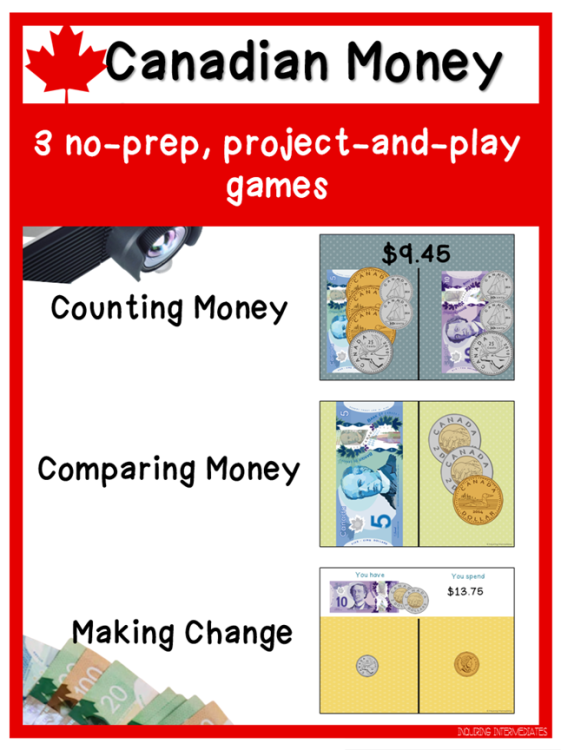
Slap games are probably the Canadian money teaching resources that I use most frequently. They’re a great way to practice concepts when you have a few spare minutes in your day, and kids will beg to play more! These games are literally no prep, and the only supplies you need are a projector and the slides. Simply divide the class in half and have each group line up on opposite sides of the classroom. Cue up the game on the projector, then call the first student from each line up to the board. The two students race to slap the side that shows the right amount (it could be the amount that matches the value up top, the larger amount, or the change that would be made from a particular purchase). If neither or both sides is/are correct, students put their hands in the air and refrain from slapping anything. This discourages blind guessing. You also only get one slap per turn, so you have to think fast! Sometimes, my class plays for points. Other times, they do it Last One Standing style, where the winner goes to the back of the line and the other player goes back to their desk. Either way, these games are always a hit!
There are three Canadian money slap games I play with my students and each one is for a different skill:
Stand Up, Sit Down Rounding Game
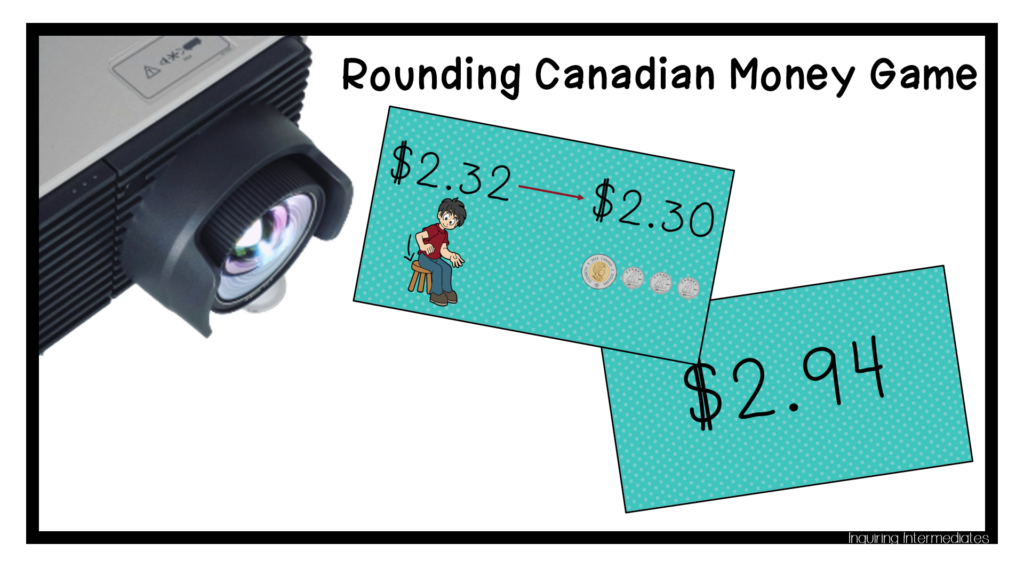
Learning to round to the nearest coin or bill is an underrated skill, and it’s not intuitive for kids who have been taught that anything bigger than 5 rounds up. Although adults often use cards or apps to pay, most kids will still be paying with cash when they go out with their friends. To practice this skill and give the class a little mathematical body break, I like to use this rounding Canadian money game. Start by projecting the game and getting kids to stand in front of their chairs. Then, show the first game slide; it will show a monetary amount. If that amount would round UP to the nearest coin or bill (for example, $1.98 would round to $2), students stay standing. If it would round DOWN (for example, $1.97 would round to $1.95), students sit down.
I couldn’t find any other resources that focused on this skill, so I made three more: a set of rounding Canadian money worksheets, a hands-on rounding Canadian money number line, and a money rounding game that can be used as a shopping simulation or matching game.
Shopping Game
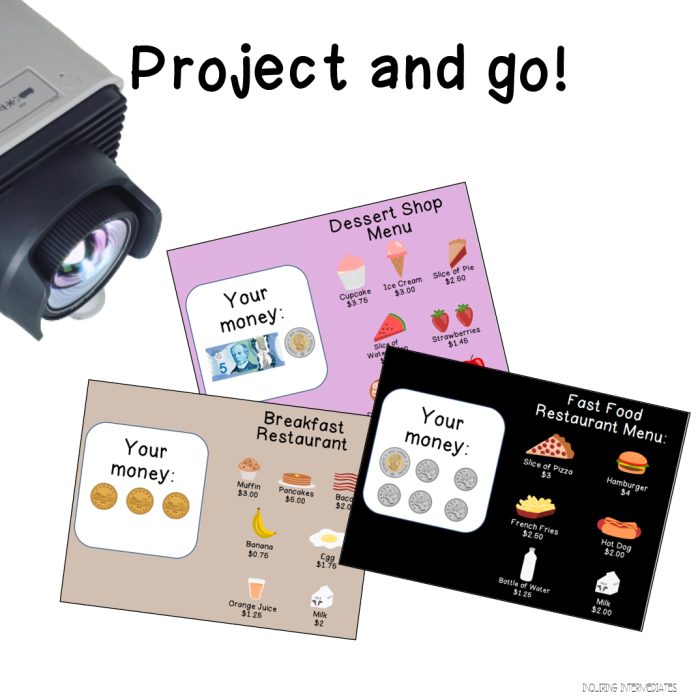
This shopping simulation can be done right at students’ desks with just play money and a projector. Here’s how to play:
-
It’s best if students are sitting in groups so they can share play money. Give each group a large handful of pretend bills and coins.
-
Put students into pairs. One partner will be the shopkeeper, and the other will be the customer.
-
Project one of the storefronts from the Shopping Activity. ‘Customers’ can take the play money they need and place orders with the shopkeeper. The shopkeeper can use money from the shared stash to make change.
Some storefront slides tell customers exactly how much money they have and in what denominations. Others just show the products available for purchase and how much they cost. If you chose to use the latter, you could give customers a budget. That would give students an opportunity to see how many ways a monetary amount could be made!
This resource also includes accompanying worksheets for teachers who want some on-paper practice too.
Looking for more Canadian money resources?
If you’re passionate about building financial literacy in Canadian kids and want more resources to help you teach about Canadian money, I’ve got you! Check out my Canadian Money Worksheets and Games Growing Bundle. It has over a dozen resources specifically made for Canadian kids and teachers. And, because I know how hard it can be to find Canadian content in online teacher spaces, I’ve set it at fairly steep discount.
Interested in reading about a fun financial literacy, art, and STEM project I did with my students? Check out this post!